TL;DR
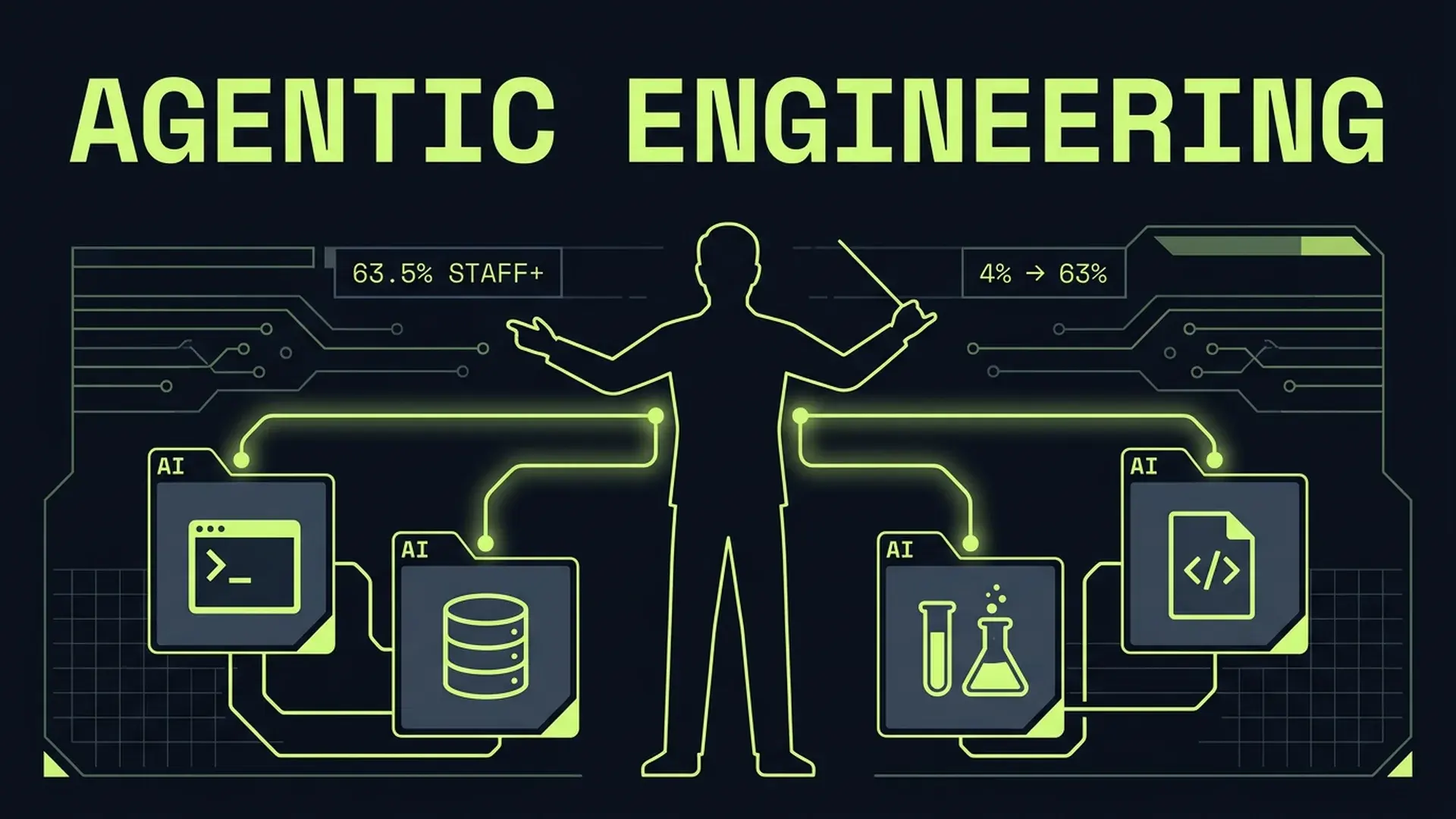
The Pragmatic Engineer survey (n=906, Feb 2026) found 95% of professional developers use AI tools weekly, with 56% doing 70%+ of their work with AI assistance. Claude Code went from 4% to 63% adoption in 8 months. Staff+ engineers lead adoption at 63.5% vs 49.7% for regular engineers. PR review time has increased 91% with AI tools. The shift from writing code to directing AI agents isn't a tool upgrade... it's a fundamental change to how engineering teams operate. Sprint structures, code ownership models, review processes, and hiring criteria all need to change. This is a management discipline, not a technology choice.
Part of the AI-Assisted Development Guide ... from code generation to production LLMs.
The Orchestrator Shift
For 50 years, a software engineer's primary job was writing code. Understanding requirements, designing solutions, typing out implementations, debugging failures. The core loop was think-write-test-iterate, and every tool in the ecosystem optimized one of those steps.
That model is breaking down.
The Pragmatic Engineer survey (n=906, Feb 2026) found that 55% of professional developers regularly use AI agents... not autocomplete, not suggestion engines, but autonomous agents that take a task description and produce working implementations. 70% use 2-4 AI tools simultaneously. 15% use five or more. Claude Code went from 4% market share to 63% in eight months... one of the fastest adoption curves for any developer tool in recent memory.
The developer's primary job is shifting from writing code to directing agents that write code. The mental model is closer to a film director than a screenwriter... you're not producing the artifact yourself, you're specifying what the artifact should be and evaluating whether the output meets the standard.
This analogy is imperfect but useful. A director who doesn't understand cinematography can't direct a camera operator. A developer who doesn't understand software architecture can't direct an AI agent. The knowledge requirement doesn't decrease... it changes shape. You need the same depth of understanding, but you deploy it differently.
In practice, the teams that struggle with agentic workflows aren't the ones with weak engineers. They're the ones that treat AI agents as faster typists rather than as a fundamentally different production model.
What Actually Changed
The transition from writing to orchestrating affects four core engineering processes. Each one needs deliberate redesign, not gradual adaptation.
Sprint Structure: Velocity Metrics No Longer Measure What Matters
Traditional sprint velocity measures story points completed per sprint. Story points are estimated based on implementation complexity. When AI agents handle implementation, the complexity shifts from writing to specifying, reviewing, and integrating. A task that used to be "8 points because the implementation is complex" becomes "2 points to implement, 6 points to review and validate."
Most teams don't adjust their estimation model. They see velocity spike 3-5x in the first month of AI adoption, declare success, and don't notice that defect rates are climbing until quarter 2.
The fix isn't complicated, but it requires discipline. Decompose every story into four phases:
## Story: Implement rate limiting for API endpoints

### Phase 1: Specification (1 point)

- Define rate limit thresholds per endpoint tier
- Document failure behavior (429 response, retry-after header)
- Specify monitoring requirements (metrics, alerts)

### Phase 2: Agent-Assisted Implementation (1 point)

- Direct agent to implement with specification as context
- Provide architectural constraints (middleware pattern, Redis backend)

### Phase 3: Verification (3 points)

- Review generated code for architectural conformance
- Verify edge cases: concurrent requests, Redis unavailability, distributed deployment
- Load test at 2x expected peak
- Security review: timing attacks, header spoofing

### Phase 4: Integration (2 points)

- Merge with existing middleware chain
- Update API documentation
- Deploy to staging, verify with production-like traffic
The total is 7 points, but the distribution changed. Implementation dropped from 60% to 15% of the effort. Verification expanded from 20% to 45%. Teams that don't rebalance their estimation will consistently under-budget the verification phase.
Code Ownership: Git Blame Becomes Meaningless
When an AI agent writes the code and a human reviews it, who owns it?
Git blame says the human who committed it. But that human didn't design the implementation... they evaluated it. They know it passed their review criteria at the time of merge. They don't necessarily understand every decision the agent made inside the implementation.
This creates a dangerous gap. When an incident hits module X at 2 AM, the on-call engineer looks at git blame, finds the name of the person who merged the AI-generated code, and pages them. That person can explain the specification they gave the agent and the review criteria they applied. They can't necessarily explain why the agent chose a particular data structure, why it handles the edge case in a specific way, or what invariants the implementation assumes.
The fix: replace individual code ownership with team-based module ownership and mandatory comprehension documentation.
# CODEOWNERS (updated for agentic workflow)
# Module owners are TEAMS, not individuals
src/api/rate-limiting/    @team-platform
src/services/billing/     @team-revenue
src/auth/                 @team-security

# Every AI-generated module requires a DECISIONS.md
src/api/rate-limiting/DECISIONS.md  # WHY this approach, not just WHAT it does
The DECISIONS.md file captures what git blame used to capture implicitly: the reasoning behind the implementation. When the agent generates code, the orchestrating engineer documents why they accepted this specific approach over alternatives. This takes ~15 minutes per PR. It saves hours during incident response.
Code Review: 91% Longer, Different Skills Required
The Pragmatic Engineer data shows PR review time increased 91% at teams using AI agents. This isn't a problem... it's the correct response.
Reviewing AI-generated code requires different skills than reviewing human-written code. Human code has a traceable thought process... you can see the developer's reasoning in the progression of changes, the commit messages, the PR description. AI-generated code arrives fully formed with no visible reasoning.
The review shifts from "does this implementation look correct" to three distinct evaluations:
Specification review. Did the orchestrator correctly translate the business requirement into an agent specification? This is where most agentic bugs originate... not in the agent's output, but in the human's input. Missing edge cases, underspecified failure modes, ambiguous success criteria.
Architectural conformance. Does the generated code follow your established patterns? AI agents don't know your architecture. They generate idiomatic code for the language, not idiomatic code for your codebase. A reviewer needs to check that the generated code uses your service layer, follows your error handling conventions, and respects your module boundaries.
Behavioral verification. Does the code actually do what the specification requires? This is where traditional code review skills still apply... reading the implementation, tracing the logic, identifying edge cases. The difference is that the reviewer doesn't have the benefit of understanding the author's reasoning, because the "author" is an AI agent.
// AI agent output - review checklist example
// [x] Uses repository pattern (not direct DB access) ✓
// [x] Error handling uses Result<T, AppError> pattern ✓
// [ ] Missing: retry logic for transient Redis failures ✗
// [ ] Missing: circuit breaker for downstream service calls ✗
// [ ] Concern: hardcoded timeout (5000ms) should use config ✗

export async function processPayment(
	paymentId: string,
	amount: number
): Promise<Result<PaymentReceipt, AppError>> {
	const payment = await paymentRepository.findById(paymentId);
	if (!payment) {
		return err(new NotFoundError(`Payment ${paymentId} not found`));
	}
	// Agent didn't add retry logic for Stripe API calls
	const stripeResult = await stripeClient.charge(payment.customerId, amount);
	// ...
}
Hiring Criteria: What to Look for in the Agentic Era
The skill profile for agentic engineering is closer to a technical architect than a traditional developer.
Strong specification skills. Can the candidate decompose ambiguous requirements into precise, testable specifications? In practice, this is the single biggest predictor of agentic productivity. Engineers who write vague prompts get vague code. Engineers who write precise specifications with explicit constraints, edge cases, and failure modes get code that's 70-80% production-ready on the first generation.
Architecture fluency. Can the candidate evaluate whether generated code conforms to a given architectural pattern? This requires deep understanding of patterns, not just familiarity with them. The candidate needs to spot when an AI agent generates a repository that bypasses the service layer, or when generated error handling doesn't match the codebase convention.
Debugging without context. Can the candidate debug code they didn't write and don't have the original reasoning for? This is the core skill of agentic engineering. Ask candidates to debug a real (anonymized) AI-generated module with a planted defect. Watch how they build a mental model of code that has no commit history, no design document, and no author to ask.
Review stamina. AI agents generate a high volume of code. Can the candidate maintain review quality across 500+ lines per PR without rubber-stamping? The teams I advise test this explicitly in interviews... give the candidate a large AI-generated PR with 3 subtle bugs and 2 architectural violations. Measure what they catch.
The Tool Landscape in March 2026
The agentic tool market has consolidated rapidly. Understanding the landscape matters because tool choice shapes workflow.
| Tool | Market Position | Primary User Base | Key Differentiator |
|---|---|---|---|
| Claude Code | 63% adoption (startups: 75%) | Staff+ engineers, startups | Terminal-native, full codebase context, agentic by default |
| Cursor | 42% adoption | Mid-level engineers, frontend teams | IDE-native, strong editor integration |
| GitHub Copilot | 56% enterprise (10K+ employees) | Enterprise teams | Procurement-friendly, GitHub ecosystem integration |
| OpenAI Codex | Growing | Research teams, AI-native startups | Deep reasoning, multi-file refactoring |
The adoption pattern tells a story. Startups choose Claude Code at 75% because it requires the least workflow change for experienced developers... it runs in the terminal, understands git, and operates on the full codebase. Large enterprises choose GitHub Copilot at 56% because it clears procurement, integrates with existing GitHub Enterprise workflows, and has Microsoft's enterprise support infrastructure. The tool preference is driven by procurement process, not by capability.
70% of developers now use 2-4 tools simultaneously. The typical stack: one agentic tool (Claude Code or Cursor) for implementation, one completion tool (Copilot) for inline suggestions, and one or more specialized tools for code review, test generation, or documentation. Tool sprawl is the new dependency sprawl.
The Staff+ Advantage
The Pragmatic Engineer survey surfaced a counterintuitive finding: staff+ engineers adopt AI agents at 63.5% vs 49.7% for regular engineers. Senior people are adopting faster, not slower.
This makes sense when you consider what agentic engineering actually requires. Senior engineers have three advantages.
Deep pattern recognition. They've seen enough implementations to know when an AI agent's output is architecturally wrong, even if it's functionally correct. A junior engineer sees code that passes tests and accepts it. A staff engineer sees code that passes tests but violates the module boundary pattern and rejects it.
Specification precision. Years of writing requirements, reviewing designs, and explaining systems to stakeholders have trained senior engineers to be precise about specifications. That precision translates directly to agent prompt quality. In my experience, staff+ engineers produce 40-50% fewer agent iterations to reach an acceptable output because their initial specifications are more complete.
Systems thinking. Senior engineers understand second and third-order effects. When an AI agent generates a rate limiter, a staff engineer asks: "What happens when this interacts with the connection pool? What about the retry logic in the downstream client? Does this respect the circuit breaker thresholds?" A junior engineer evaluates the rate limiter in isolation.
This creates an organizational tension. The people who benefit most from AI agents are your most expensive engineers. The people who benefit least are the ones you'd most want to accelerate. The productivity gap between senior and junior engineers isn't closing with AI adoption... it's widening.
The Multi-Agent Production Pattern
The next phase of agentic engineering isn't one developer directing one agent. It's one developer orchestrating multiple agents working in parallel.
The pattern works best for tasks that can be decomposed into independent work streams with well-defined interfaces:
## Multi-Agent Task Decomposition Example

### Feature: User notification preferences system

Agent 1 (Backend): Build notification preferences API

- Specification: REST endpoints for CRUD on notification preferences
- Constraints: Repository pattern, PostgreSQL, typed responses
- Interface contract: OpenAPI spec (provided)

Agent 2 (Frontend): Build notification preferences UI

- Specification: React component with form validation
- Constraints: Design system components, server actions for mutations
- Interface contract: Same OpenAPI spec

Agent 3 (Testing): Generate integration test suite

- Specification: Test preference CRUD, edge cases, error states
- Constraints: Vitest, test-database pattern, no mocking of core logic
- Interface contract: Same OpenAPI spec

Human orchestrator responsibilities:

- Define the interface contract BEFORE agents start
- Review each agent's output for specification conformance
- Verify integration between Agent 1 and Agent 2 outputs
- Evaluate Agent 3's test coverage for missing scenarios
The critical constraint is the interface contract. Multi-agent workflows fail when agents generate incompatible implementations because they weren't given a shared specification. The orchestrator's job is defining that specification precisely enough that independently-generated components integrate cleanly.
SWE-bench benchmarks show the ceiling for single-agent performance on verified benchmarks at ~81%, dropping to 46-57% on uncontaminated (SWE-bench Pro) benchmarks. Multi-agent patterns don't beat these numbers on individual tasks. They beat them on throughput... completing 3 tasks in parallel with 70% first-pass quality beats completing 1 task at 80% quality when the review-and-fix cycle is fast enough.
Operational Metrics for Agentic Teams
Lines of code, commits per day, and PRs merged are noise metrics in the agentic era. Here's what to measure instead.
Specification-to-Production Ratio. How many agent iterations does it take to go from initial specification to merged, production-ready code? Track this per engineer. High ratios indicate specification quality problems, not agent quality problems.
Review Catch Rate. What percentage of AI-generated PRs require changes during review? A healthy rate is 60-80%. Below 60% suggests rubber-stamping. Above 80% suggests the agent specifications are too vague.
Incident Attribution. When production incidents occur, track whether the root cause was in AI-generated code, human-written code, or integration between the two. If AI-generated code causes a disproportionate share of incidents, your review process needs tightening.
Comprehension Coverage. For each module in your codebase, can at least two engineers explain its invariants, failure modes, and design decisions? Track this as a percentage. Below 70% means your team can't safely maintain the system.
Time-to-Diagnosis. When something breaks, how long does it take to identify the root cause? This metric captures the hidden cost of AI debt... code that works but nobody understands takes dramatically longer to debug. Track the trend quarterly.
// Example: tracking specification-to-production ratio
interface AgentTaskMetrics {
	taskId: string;
	specificationVersion: number; // How many spec revisions before agent start
	agentIterations: number; // How many agent runs to get acceptable output
	reviewCycles: number; // How many review rounds before merge
	totalTimeMinutes: number; // Wall clock from spec to merge
	productionIncidents: number; // Incidents in first 30 days post-merge
}

// Target: agentIterations <= 3, reviewCycles <= 2
// If consistently above: specification quality needs workWhen NOT to Go Agentic
Agentic engineering isn't universally superior. Several contexts actively punish the orchestrator model.
Solo developers on small codebases. If you're the only engineer and the codebase is under 20K lines, the overhead of formal specification and review processes exceeds the benefit of agent-generated code. You're faster just writing it yourself because the specification IS your internal mental model. You don't need to externalize it for an agent.
Security-critical systems with audit requirements. If your code requires SOC 2, HIPAA, or FedRAMP compliance with line-by-line audit trails, AI-generated code creates documentation burdens that can exceed the productivity gains. The auditor wants to know who decided to use this encryption algorithm and why. "The AI agent generated it and a human reviewed it" isn't a satisfying answer... yet.
Teams with no senior engineers. Agentic engineering requires the ability to evaluate AI output against architectural standards. Teams composed entirely of junior and mid-level engineers lack the pattern recognition to catch architectural violations in generated code. The 63.5% vs 49.7% adoption gap between staff+ and regular engineers exists for a reason.
Highly regulated industries in early AI adoption phases. If your regulators haven't issued guidance on AI-generated code in your domain (medical devices, avionics, financial trading systems), adopting agentic workflows creates regulatory risk that no productivity gain justifies.
Codebases where the AI context window isn't sufficient. If your codebase has deep, cross-module dependencies that exceed current context window limits, agents will generate code that's locally correct but globally inconsistent. You'll spend more time fixing integration issues than you saved on implementation.
FAQ
Does agentic engineering mean junior developers are obsolete?
No, but their role changes. Junior engineers in agentic teams focus on specification writing, test case design, and review apprenticeship under senior engineers. The "learn by writing code" pathway gets supplemented by "learn by reviewing and debugging agent-generated code." In practice, junior engineers often accelerate their architectural understanding faster through agent code review than through traditional implementation... they see more patterns and more failure modes per unit of time. The catch: they need structured mentorship to process what they're seeing.
How do you handle code ownership when agents write 70%+ of the code?
Team-based ownership with mandatory comprehension documentation. Every AI-generated module gets a DECISIONS.md file capturing the specification, the architectural rationale, and the key review findings. Module ownership rotates quarterly so no single engineer becomes the sole knowledge holder. The 91% increase in review time is partially offset by reducing the context-rebuilding time during incident response.
What's the actual productivity gain from agentic engineering?
It depends on the task profile. For boilerplate-heavy implementation (CRUD endpoints, standard UI forms, test scaffolding), productivity gains are 3-5x. For complex architectural work, gains are 0.5-1.5x... meaning some tasks are actually slower. The aggregate across a typical sprint is 1.5-2x for experienced teams, dropping to 0.8-1.2x for teams that haven't adjusted their review and specification processes. The METR study's finding that experienced developers were 19% slower applies specifically to complex tasks on mature codebases... and it's consistent with what I see in practice.
Should we standardize on one AI tool or let engineers choose?
Standardize on 1-2 primary tools with team-wide configuration (architectural context files, coding standards, review templates). Tool choice affects code style, and multiple AI tools in one codebase create style inconsistency that makes review harder. Allow personal-preference tools for exploration and prototyping, but require that all production-bound code goes through the standardized tool with shared configuration.
How does agentic engineering affect technical interviews?
Traditional coding interviews (LeetCode, whiteboard algorithms) test a skill that's becoming less relevant. Interview for specification precision, architectural reasoning, code review ability, and debugging skills on unfamiliar code. Give candidates a real (anonymized) AI-generated module with planted issues and evaluate their ability to identify the specification gap, the architectural violation, and the functional bug. This tests exactly the skills they'll use on the job... and it can't be gamed by having an AI agent solve the interview for them.
Transitioning your engineering team to agentic workflows? I help CTOs redesign sprint structures, review processes, and hiring criteria for the orchestrator model.
Continue Reading
This post is part of the AI-Assisted Development Guide ... covering code generation, LLM architecture, prompt engineering, and cost optimization.
More in This Series
- AI-Assisted Development Guide ... The comprehensive framework
- Stop Calling It Vibe Coding ... What AI-assisted development actually requires
Building an agentic engineering practice? Work with me on redesigning your team's workflow for the orchestrator model.