TL;DR
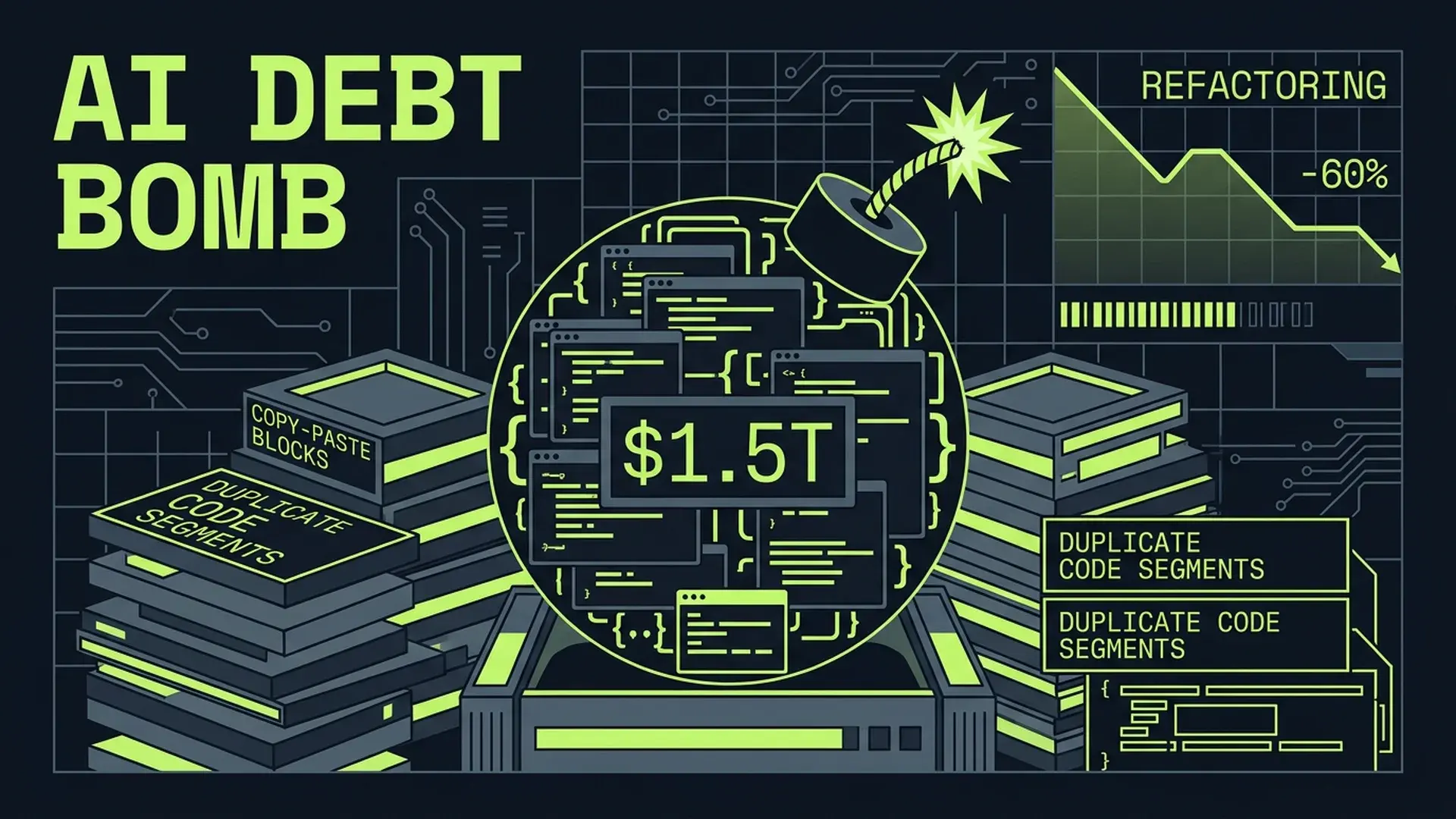
Forrester projects $1.5 trillion in accumulated AI-generated technical debt by 2027, with 75% of tech decision-makers already reporting moderate-to-severe AI debt in their codebases. GitClear's analysis of 211 million lines of code shows refactoring activity declining from 25% (2021) to under 10% (2024), while copy-paste code rose from 8.3% to 12.3%. Year 2 maintenance costs for unmanaged AI code run 4x higher than traditional codebases. This isn't a distant risk... it's a balance sheet liability accumulating right now. Here's the accounting framework, audit checklist, and remediation playbook.
Part of the AI-Assisted Development Guide ... from code generation to production LLMs.
The $1.5 Trillion Projection
The number sounds absurd until you decompose it.
Forrester's model works backward from three inputs: the percentage of enterprise code now AI-generated (~40% and rising), the higher defect and churn rates that AI code carries, and the compounding cost of maintaining code nobody fully understands. When 75% of tech decision-makers report moderate-to-severe AI debt in their organizations, the aggregate isn't a projection... it's an extrapolation of what's already happening.
Here's what makes AI debt different from previous "debt bubbles" in software. Traditional technical debt accumulates through conscious trade-offs... you skip tests to hit a deadline, you hard-code a configuration to ship a feature, you defer a migration because the risk outweighs the benefit this quarter. Teams know they're taking on debt. They can estimate the interest rate.
AI debt accumulates unconsciously. Every accepted Copilot suggestion, every Claude Code output merged without deep review, every AI-generated module that "works" but nobody can explain... each one adds to the principal without appearing on any ledger. The Harness 2025 developer survey found that a majority of engineers spend more time debugging AI-generated code than they would have spent writing the equivalent manually. The code shipped faster. The total cost was higher.
In practice, I've started calling this "phantom velocity." The sprint velocity chart looks great. PRs are merging faster. Lines of code are up. But the maintenance burden in months 6-18 is 3-4x what the team budgeted for, because nobody factored in the cost of understanding, debugging, and eventually rewriting code that was generated rather than designed.
Why AI Debt Is Different from Traditional Technical Debt
This distinction matters because the remediation strategies are fundamentally different.
| Dimension | Traditional Tech Debt | AI-Generated Tech Debt |
|---|---|---|
| How it accumulates | Conscious trade-offs (skip tests, defer refactors) | Unconscious acceptance of generated code |
| Visibility | Teams know it exists; can estimate magnitude | Invisible until Year 2 maintenance spike |
| Who understands the code | Original author + reviewers | Often nobody... author accepted, didn't design |
| Refactoring cost | Proportional to complexity | Proportional to comprehension gap |
| Duplication pattern | Spotted in review, caught by linters | Subtle variations that evade tooling |
| Architectural coherence | Degrades slowly with team turnover | Degrades immediately... AI doesn't know your patterns |
| Documentation | Missing but could be retroactively written | Writing docs for code you don't understand is circular |
| Interest rate | Linear... maintenance grows proportionally | Exponential... Year 2 costs 4x, Year 3 costs 8-12x |
The exponential interest rate is the critical difference. Traditional debt grows linearly because the team that created it still understands it. They can estimate the cost to fix it. They can navigate around it. AI debt compounds because the comprehension gap widens with every new feature built on top of code nobody fully understands.
CodeRabbit's analysis of pull requests across thousands of repositories found that AI-generated code carries 1.7x more bugs and 322% more security vulnerabilities than human-written code. Stack Overflow's developer survey shows only 3.1% of developers highly trust AI-generated output, yet the same survey shows that a significant majority accept AI suggestions without thorough review. Trust is low. Behavior hasn't changed. That gap is where the debt accumulates.
The GitClear Data: 211 Million Lines of Evidence
GitClear's longitudinal analysis provides the most granular view of how AI tools change code evolution patterns. The dataset... 211 million lines of changed code across thousands of repositories from 2020 to 2024... reveals three trends that should concern every CTO.
Refactoring Is Dying
Refactored code as a percentage of total code changes declined from ~25% in 2021 to under 10% in 2024. This isn't teams deciding their code is clean enough to skip refactoring. It's teams generating new code faster than they can maintain existing code.
Refactoring is how codebases stay healthy. It's the software equivalent of preventive maintenance. When refactoring drops, you aren't saving time... you're deferring costs to future quarters. The code still needs the refactoring. The structural issues still exist. You've just stopped paying interest on the debt, which means the principal is growing unchecked.
In practice, this shows up as modules that nobody wants to touch. I call them "frozen zones"... sections of the codebase where the team routes around problems rather than fixing them because the cost of understanding the code exceeds the cost of building a workaround. Most AI-heavy codebases now carry at least 3-5 frozen zones that didn't exist 18 months ago.
Copy-Paste Code Is Surging
Copy-pasted code rose from 8.3% to 12.3% of total code changes. More alarming: GitClear found an 8-fold increase in code blocks that duplicate adjacent code... meaning developers are accepting AI suggestions that repeat patterns already present in nearby files rather than abstracting them.
This isn't the obvious copy-paste that linters catch. It's structural duplication... the same pattern implemented with slightly different variable names, the same API call wrapped in slightly different error handling, the same validation logic expressed in three different ways across three endpoints. Each instance works. The aggregate creates a maintenance nightmare because a business logic change requires updating 3, 5, or 12 locations instead of one.
// AI generates this pattern in user-service.ts
async function getUserSubscription(userId: string): Promise<Subscription> {
	const response = await db.query(
		"SELECT * FROM subscriptions WHERE user_id = $1 AND status = $2",
		[userId, "active"]
	);
	if (!response.rows.length) {
		throw new NotFoundError("No active subscription");
	}
	return mapSubscription(response.rows[0]);
}

// Then generates this near-identical pattern in billing-service.ts
async function getActiveSubscription(customerId: string): Promise<BillingSubscription> {
	const result = await db.query("SELECT * FROM subscriptions WHERE user_id = $1 AND status = $2", [
		customerId,
		"active",
	]);
	if (!result.rows.length) {
		throw new Error("Subscription not found");
	}
	return toBillingSubscription(result.rows[0]);
}
Same query. Different variable names. Different error types. Different mapper functions. Both work. When the subscription schema changes, you'll fix one and forget the other. The bug will surface in production 3 weeks later.
Code Churn Is Accelerating
Code rewritten within 14 days of being written... a strong signal of premature or incorrect implementation... has increased significantly in repositories with heavy AI tool usage. Teams are generating code faster, then spending more time fixing it.
The net effect: velocity metrics go up while throughput stays flat or declines. You're running faster on a treadmill.
The AI Debt Accounting Framework
Every CTO needs a system for measuring, categorizing, and prioritizing AI-generated debt. Here's the framework I use with advisory clients.
Step 1: Track Code Origin
You can't manage what you don't measure. Every merged PR should be tagged with its generation method.
# PR template addition
code_origin:
  - fully_human # Written by hand
  - ai_assisted # AI suggested, human modified significantly
  - ai_generated # AI generated, human reviewed and accepted
  - ai_unreviewed # AI generated, merged without deep review (be honest)
Most teams resist the "ai_unreviewed" category. Use it anyway. The point isn't blame... it's risk mapping. Teams routinely underestimate the percentage of AI-generated code they merge without deep review by ~40%. The label forces honesty.
Step 2: Categorize the Debt
Not all AI debt is equal. Different categories require different remediation strategies.
Copy-Paste Debt. Duplicated patterns that should be abstracted into shared utilities. Detection: static analysis tools (SonarQube, CodeClimate) tuned for structural similarity, not just exact matches. Remediation: extract shared functions, establish pattern libraries. Cost: moderate... time-consuming but straightforward.
Comprehension Debt. Code that works but nobody on the team can explain. Detection: the "explain this" test... pick a random AI-generated module and ask the responsible engineer to explain its invariants, edge cases, and failure modes in a code review setting. If they can't, you have comprehension debt. Remediation: forced comprehension reviews, architecture decision records (ADRs), pair debugging sessions. Cost: high... requires senior engineer time.
Architectural Drift. AI-generated code that violates your architectural patterns. Detection: architectural fitness functions, dependency analysis, module coupling metrics. Remediation: refactoring to align with established patterns, updating AI context to include architectural constraints. Cost: very high... often requires rewriting modules, not just refactoring them.
Step 3: Model the Costs
The cost curve for unmanaged AI debt isn't linear. It's exponential.
| Time Period | Traditional Debt Maintenance | AI Debt Maintenance | Multiplier |
|---|---|---|---|
| Year 1 | 1x (baseline) | 1.2x | 1.2x |
| Year 2 | 1.3x | 4.0x | 3.1x |
| Year 3 | 1.5x | 8-12x | 5.3-8x |
The Year 2 spike happens because that's when the original developers start leaving or rotating to new projects. The comprehension that lived in their heads... partial as it was... leaves with them. New team members face a codebase where both the code and the institutional knowledge about that code are opaque.
89% of CTOs in a recent industry survey reported production disasters directly attributable to AI-generated code. Most of those disasters occurred in the 12-18 month window... long enough for the original context to fade, short enough that the code hasn't been rewritten.
The Audit Checklist
Run this quarterly. It takes 2-3 days for a mid-sized engineering org (~20-50 engineers). The insights pay for themselves in the first sprint.
1. Measure Your Refactoring Rate
Pull your git metrics for the past quarter. What percentage of code changes were refactors vs new code? If it's below 15%, your codebase is accumulating structural debt faster than you're paying it down.
# Approximate refactoring ratio from git history
# Compare commits that modify existing files vs add new files
TOTAL=$(git log --since="3 months ago" --oneline | wc -l)
NEW_FILES=$(git log --since="3 months ago" --diff-filter=A --name-only --pretty="" | wc -l)
MODIFIED=$(git log --since="3 months ago" --diff-filter=M --name-only --pretty="" | wc -l)
echo "Total commits: $TOTAL"
echo "New files added: $NEW_FILES"
echo "Existing files modified: $MODIFIED"
echo "Refactor ratio (rough): $(echo "scale=1; $MODIFIED * 100 / ($MODIFIED + $NEW_FILES)" | bc)%"
2. Run the Duplication Scan
Use SonarQube, jscpd, or CodeClimate to measure code duplication. But don't just look at the percentage... look at the trend. If duplication is increasing quarter-over-quarter, AI adoption is outpacing abstraction discipline.
# jscpd for JavaScript/TypeScript codebases
npx jscpd --min-lines 10 --min-tokens 50 \
  --reporters json \
  --output ./audit-reports/ \
  src/
3. Conduct the Comprehension Test
Select 10 modules at random from code merged in the past 6 months. For each module, ask the engineer listed in git blame to explain:
- What are this module's invariants?
- What happens when the primary dependency is unavailable?
- What are the known edge cases?
- Why was this approach chosen over the obvious alternative?
Score each answer on a 1-5 scale. Any module scoring below 3 has significant comprehension debt. In my experience, 40-60% of AI-heavy modules fail this test.
4. Map Your Frozen Zones
Identify modules that haven't been modified in 6+ months despite having open bugs or known limitations. These are your frozen zones... code so opaque that the team routes around it rather than fixing it.
5. Check Architectural Conformance
Run dependency analysis against your intended architecture. Count the violations. Compare to 12 months ago. If violations are increasing, AI-generated code is drifting your architecture without anyone deciding it should.
6. Calculate Your Debt-to-Revenue Ratio
Estimate the engineering hours spent on AI-debt-related maintenance (debugging AI code, rewriting AI code, duplicating fixes across copied modules). Divide by total engineering hours. If this ratio exceeds 15%, you have a material debt problem.
The Remediation Playbook
Identifying the debt is step one. Paying it down requires disciplined, sustained effort. Here's the sequence that works.
Phase 1: Stop the Bleeding (Weeks 1-4)
Implement code origin tracking. Every PR gets tagged. No exceptions. You need the data to prioritize remediation.
Establish AI code review standards. AI-generated code requires the same review depth as junior developer code... line-by-line, with questions about intent and alternatives. The 91% increase in PR review time that teams see with AI tools isn't a problem to solve... it's the cost of responsible adoption.
Create architectural context files. Give your AI tools context about your patterns, conventions, and constraints. This won't eliminate architectural drift, but it reduces it by 30-40%.
<!-- .ai-context.md (project root) -->

# Architecture Constraints

- All database access goes through the repository layer
- Business logic lives in service classes, never in controllers
- Error handling uses typed Result<T, E> pattern
- No direct SQL queries outside repository files
Phase 2: Triage and Prioritize (Weeks 4-8)
Run the full audit. Use the checklist above. Identify your top 10 debt hotspots.
Classify by blast radius. A duplicated utility function is annoying but contained. A misunderstood authentication module is existential. Prioritize by production risk, not by size.
Create a debt backlog. Treat AI debt remediation like any other engineering work... sized, estimated, prioritized, and tracked. The teams that try to fix AI debt "when they have time" never fix it.
Phase 3: Systematic Paydown (Ongoing)
Allocate 20% of sprint capacity to debt remediation. This isn't optional. It's the interest payment that keeps the principal from compounding. Teams that skip this allocation see their effective velocity drop by 10-15% per quarter as the debt accumulates.
Rotate comprehension ownership. Every quarter, reassign module ownership to someone who didn't write (or prompt) the original code. Force them to read it, understand it, and document their findings. This converts comprehension debt into institutional knowledge.
Extract and abstract. Schedule regular duplication-reduction sprints. Identify the 3 most-duplicated patterns, extract them into shared utilities, and update the team's coding standards to reference the shared patterns.
Run chaos engineering on frozen zones. Deliberately introduce failures in modules that nobody wants to touch. This forces the team to build understanding of the code under pressure... which is better than building understanding during a real incident.
When NOT to Worry About AI Technical Debt
The framework above is built for teams that plan to maintain their codebases for 2+ years. Not every situation warrants this level of discipline.
Pre-product-market-fit startups. If you don't know whether the product will exist in 6 months, accumulate debt freely. Speed to learning matters more than code quality. The entire codebase is disposable until you find PMF.
Throwaway prototypes and proofs of concept. If the code will be rewritten once the approach is validated, AI debt is irrelevant. Generate freely, learn fast, start clean.
One-person projects with no team scaling plans. If you wrote it, you understand it. Cognitive debt can't accumulate in a team of one. AI debt only becomes a problem when other people need to maintain the code.
Competitive sprints with defined rewrite windows. If the business explicitly trades code quality for speed with a planned rewrite in 90 days, that's a conscious trade-off... which means it's traditional technical debt, not the unconscious AI variety.
The moment you hire your second engineer, plan to maintain the code for more than a year, or depend on the codebase for revenue... start measuring.
FAQ
How do I convince my board that AI technical debt is a material risk?
Translate engineering metrics into financial language. Calculate the engineering hours spent on AI-debt-related rework (debugging, rewriting, duplicated fixes). Multiply by your fully-loaded engineer cost. Present it as "unplanned maintenance spend" alongside the Year 2 cost multiplier. Boards understand compounding costs... frame AI debt like deferred infrastructure maintenance on a building. The roof looks fine until it doesn't.
Is AI-generated technical debt worse than outsourced code debt?
They share the comprehension problem... code written by people outside the team that current members don't understand. AI debt is worse in two ways: volume (AI generates code orders of magnitude faster than offshore teams) and subtlety (AI code looks correct and idiomatic, making the comprehension gap harder to detect). Outsourced code is often obviously different in style, which triggers review scrutiny. AI code blends in.
What tools can detect AI-generated technical debt specifically?
No tool specifically identifies "AI-generated" debt yet, but the signals are detectable. SonarQube catches structural duplication. GitClear tracks refactoring ratios and code churn. jscpd identifies copy-paste patterns. The comprehension test (asking engineers to explain modules) remains the most reliable detection method for the highest-risk category... code nobody understands. Track these metrics quarterly and watch the trends.
Should we limit which AI tools our team uses?
Standardize, don't limit. Pick 1-2 approved AI coding tools, configure them with your architectural context, and establish review standards specific to AI-generated code. Teams using 5+ different AI tools end up with 5 different code styles in the same codebase, which accelerates architectural drift. The tool choice matters less than the review discipline around it.
How long does it take to pay down AI technical debt?
Expect 2-4 quarters of sustained effort at 20% sprint allocation to reduce AI debt to manageable levels in a mid-sized codebase (~200K-500K lines). The first quarter shows slow progress because you're building measurement infrastructure. The second quarter shows dramatic improvement as the worst hotspots get remediated. Quarters 3-4 are about establishing the ongoing discipline that prevents reaccumulation. Teams that stop after quarter 2 see the debt return within 6 months.
Concerned about the AI debt accumulating in your codebase? I help CTOs build measurement frameworks and remediation strategies that prevent the Year 2 maintenance spike.
Continue Reading
This post is part of the AI-Assisted Development Guide ... covering code generation, LLM architecture, prompt engineering, and cost optimization.
More in This Series
- AI-Assisted Development Guide ... The comprehensive framework
- The Generative Debt Crisis ... When AI code becomes liability
- Cognitive Debt ... The hidden cost your team isn't measuring
Need an AI debt audit for your engineering org? Work with me on building a measurement-driven remediation strategy.