TL;DR
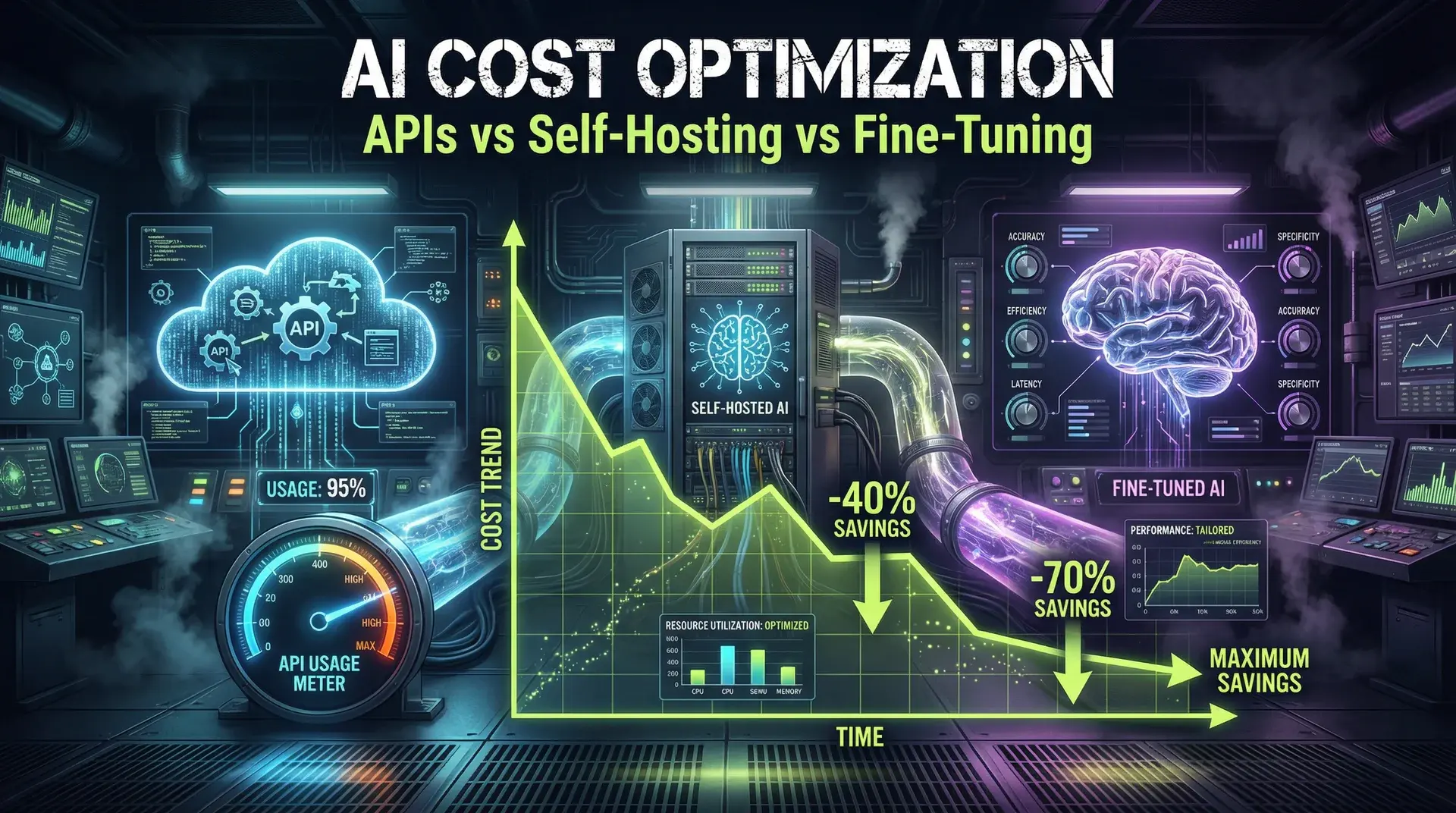
Below $2K/month API spend: stick with APIs. Above $5K/month: self-hosting pays for itself within 6 months. Fine-tuning makes sense when you need domain-specific quality that base models cannot match... expect $25/1M training tokens plus ongoing inference savings of 40-60%. Hybrid architectures win: route 80% of traffic to self-hosted models, 20% to APIs for complex tasks. Semantic caching cuts all costs by 40-60% regardless of deployment model.
Part of the AI-Assisted Development Guide ... from code generation to production LLMs.
The New Infrastructure Line Item
Every startup adding LLM capabilities faces the same spreadsheet shock. What starts as $50/day in API calls becomes $1,500/month. Then $5,000. Then someone asks the CFO why the "AI features" line item rivals their cloud hosting bill.
Startups can cut AI costs by ~70% without degrading quality. The pattern is consistent: they start with APIs because they're fast to integrate, hit a cost wall around $3-5K/month, and face a build-vs-buy decision they weren't prepared for.
This post lays out a decision framework. It covers the three deployment models... APIs, self-hosting, and fine-tuning... with specific cost thresholds, break-even calculations, and implementation patterns that actually work in production.
The Three Deployment Models
Model 1: API-Based (OpenAI, Anthropic, Groq)
The default choice for most teams. Pay per token, no infrastructure to manage.
Current Pricing (January 2026):
| Provider | Model | Input (per 1M tokens) | Output (per 1M tokens) |
|---|---|---|---|
| OpenAI | GPT-4o | $2.50 | $10.00 |
| OpenAI | GPT-4o-mini | $0.15 | $0.60 |
| Anthropic | Claude 3.5 Sonnet | $3.00 | $15.00 |
| Anthropic | Claude 3.5 Haiku | $0.25 | $1.25 |
| Groq | Llama 3.3 70B | $0.59 | $0.79 |
| Gemini 1.5 Pro | $1.25 | $5.00 |
When APIs Win:
- Monthly spend under $2K
- Variable or unpredictable load
- Rapid prototyping and MVP stage
- Tasks requiring frontier model capabilities
- No DevOps capacity for infrastructure
The hidden cost of APIs isn't the per-token price... it's the lack of control. Rate limits hit during traffic spikes. Latency varies based on provider load. Model updates change behavior without notice.
Model 2: Self-Hosted (Ollama, vLLM, TGI)
Run open-source models on your infrastructure. Fixed cost regardless of usage.
Infrastructure Options:
| Setup | Hardware | Monthly Cost | Capacity |
|---|---|---|---|
| Development | RTX 3080 (10GB) | ~$0 (owned) | Llama 3.1 8B, ~100 tok/s |
| Production (entry) | A10G (24GB) | $150-300 | Llama 3.1 70B Q4, ~30 tok/s |
| Production (mid) | A100 40GB | $800-1,200 | Llama 3.1 70B FP16, ~50 tok/s |
| Production (high) | 2x A100 80GB | $2,000-3,000 | Multiple models, high throughput |
Amortized Cost per Token:
Self-hosted Llama 3.3 70B on A100: approximately $0.50 per 1M tokens... compared to $0.59-0.79 via Groq or $10+ for equivalent API quality.
When Self-Hosting Wins:
- Consistent load above 1M tokens/day
- Latency-sensitive applications (sub-100ms requirement)
- Data sovereignty or privacy requirements
- Monthly API spend exceeding $3-5K
- Predictable, high-volume workloads
The hidden cost of self-hosting is operational complexity. Model updates, GPU monitoring, scaling, failover... someone needs to own this. If your team doesn't have DevOps capacity, the cost savings evaporate in engineering time.
Model 3: Fine-Tuned Models
Train a base model on your domain-specific data. Lower inference costs, higher quality for specific tasks.
Fine-Tuning Costs:
| Provider | Training Cost | Base Model | Notes |
|---|---|---|---|
| OpenAI | $25/1M tokens | GPT-4o-mini | Managed, limited customization |
| Together.ai | $0.002/1K tokens | Llama 3.1 | Full control, self-serve |
| Self-hosted | GPU time only | Any open model | Maximum control |
When Fine-Tuning Wins:
- Domain-specific vocabulary or knowledge (legal, medical, fintech)
- Quality requirements that prompt engineering cannot meet
- High volume of repetitive, similar tasks
- Need to distill expensive model behavior into cheaper model
- Consistent output format requirements
Fine-tuning is not a cost optimization strategy alone. It's a quality optimization that happens to reduce costs. If GPT-4o-mini with good prompts handles your use case, fine-tuning adds complexity without proportional benefit.
Cost Analysis Framework
The True Cost Equation
API cost is straightforward: tokens * price_per_token. Self-hosting and fine-tuning require accounting for hidden costs.
Self-Hosting Total Cost:
Monthly Cost = GPU Cost + Engineering Time + Monitoring + Redundancy Overhead

GPU Cost: $800/month (A100 40GB on-demand)
Engineering Time: 10 hours/month * $150/hour = $1,500
Monitoring: $50/month (observability tooling)
Redundancy: 1.5x GPU cost for failover = $400

Total: $2,750/month for ~50M tokens capacity
Effective rate: $0.055/1K tokens
Fine-Tuning Total Cost:
Upfront Cost = Training Data Prep + Training Runs + Evaluation

Training Data: 20 hours * $150/hour = $3,000
Training Runs: 10M tokens * $25/1M = $250
Evaluation: 5 hours * $150/hour = $750

Total Upfront: $4,000
Ongoing Inference: 40-60% cheaper than base model
Break-even: 2-4 months at high volume
Break-Even Calculations
API vs Self-Hosting:
At GPT-4o rates ($10/1M output tokens), break-even occurs around:
- 5M tokens/month: APIs win (cost: $50 vs $2,750 self-hosted)
- 50M tokens/month: Close (cost: $500 vs ~$600 amortized self-hosted)
- 500M tokens/month: Self-hosting wins decisively ($5,000 vs $2,750)
The break-even point shifts based on model choice. If you can use GPT-4o-mini ($0.60/1M output), self-hosting rarely makes financial sense for pure API replacement. The calculus changes when you factor in latency requirements or data privacy.
API vs Fine-Tuned:
Fine-tuned GPT-4o-mini costs ~$1.20/1M output tokens. Compared to base GPT-4o at $10/1M:
- 500K tokens/month: Fine-tuning loses ($600 fine-tuned vs $5,000 base, but upfront cost of $4,000 takes 8 months to recover)
- 5M tokens/month: Fine-tuning wins decisively ($6,000/month saved after month 1)
Fine-tuning only makes financial sense at high volume or when quality improvements justify the upfront investment.
Decision Matrix
When APIs Win
Threshold: Monthly spend under $2K, variable load, MVP stage
def should_use_api(monthly_tokens: int, load_variance: float, team_has_devops: bool) -> bool:
    monthly_cost = estimate_api_cost(monthly_tokens)

    # APIs win when:
    # 1. Cost is below threshold
    if monthly_cost < 2000:
        return True

    # 2. Load is too variable to size infrastructure
    if load_variance > 0.5:  # More than 50% variance
        return True

    # 3. No capacity to manage infrastructure
    if not team_has_devops:
        return True

    return False
Real Scenario: A B2B SaaS with 100 users making 50 queries/day. At 500 tokens/query average, that's 2.5M tokens/day or 75M tokens/month. GPT-4o-mini cost: $45/month. No reason to self-host.
When Self-Hosting Wins
Threshold: Monthly API spend exceeding $3-5K, consistent load, latency requirements
def should_self_host(
    monthly_api_cost: float,
    latency_requirement_ms: int,
    data_sensitivity: str,
    load_consistency: float
) -> bool:
    # Self-hosting wins when:

    # 1. Cost justifies infrastructure investment
    if monthly_api_cost > 5000 and load_consistency > 0.7:
        return True

    # 2. Latency requirements can't be met by APIs
    if latency_requirement_ms < 200:  # Most APIs: 500-2000ms
        return True

    # 3. Data cannot leave your infrastructure
    if data_sensitivity in ["pii", "hipaa", "financial"]:
        return True

    return False
Real Scenario: A customer support chatbot handling 50K messages/day at 1,000 tokens average. Monthly tokens: 1.5B. GPT-4o-mini cost: $900/month output tokens alone. Self-hosted Llama 3.1 70B on A100: $1,200/month all-in, with sub-100ms latency and no rate limits. Break-even at 1.3x current volume.
When Fine-Tuning Wins
Threshold: Domain-specific quality requirements, high volume of similar tasks, budget for upfront investment
def should_fine_tune(
    domain_specificity: str,
    prompt_engineering_quality: float,
    monthly_volume: int,
    budget_for_upfront: bool
) -> bool:
    # Fine-tuning wins when:

    # 1. Domain requires specialized knowledge
    if domain_specificity in ["legal", "medical", "fintech"] and prompt_engineering_quality < 0.8:
        return True

    # 2. Volume justifies training investment
    if monthly_volume > 10_000_000 and budget_for_upfront:  # 10M tokens/month
        return True

    # 3. Output format consistency is critical
    # (Fine-tuned models follow formats more reliably)

    return False
Real Scenario: A legal document review tool needs to identify 47 specific clause types with 95%+ accuracy. GPT-4o with detailed prompts achieves 82%. Fine-tuned Llama 3.1 8B achieves 94% after training on 100K labeled examples. Training cost: $4,000. Inference savings: 80% (smaller model, self-hosted). Quality improvement justifies investment.
Implementation Patterns
Pattern 1: Hybrid Routing
Route traffic based on task complexity. Use expensive models only when necessary.
from enum import Enum
from typing import Literal

class TaskComplexity(Enum):
    SIMPLE = "simple"      # Classification, extraction
    MODERATE = "moderate"  # Summarization, Q&A
    COMPLEX = "complex"    # Reasoning, creative writing

class HybridRouter:
    def __init__(self):
        self.local_client = OllamaClient(model="llama3.1:8b")
        self.api_client = OpenAIClient(model="gpt-4o-mini")
        self.premium_client = OpenAIClient(model="gpt-4o")
        self.classifier = load_complexity_classifier()

    async def route(self, prompt: str, context: str) -> tuple[str, str]:
        complexity = self.classifier.predict(prompt, context)

        if complexity == TaskComplexity.SIMPLE:
            # 80% of traffic: local model, $0/token
            response = await self.local_client.generate(prompt)
            return response, "local"

        elif complexity == TaskComplexity.MODERATE:
            # 15% of traffic: cheap API, $0.60/1M tokens
            response = await self.api_client.generate(prompt)
            return response, "api_mini"

        else:
            # 5% of traffic: premium API, $10/1M tokens
            response = await self.premium_client.generate(prompt)
            return response, "api_premium"
Cost Impact: An application sending 10M tokens/month entirely to GPT-4o costs $100K/year. With hybrid routing (80/15/5 split), cost drops to ~$8K/year...92% reduction.
Pattern 2: Semantic Caching
Many queries are semantically equivalent. Cache responses and match on similarity.
import hashlib
from typing import Optional
from qdrant_client import QdrantClient
from sentence_transformers import SentenceTransformer

class SemanticCache:
    def __init__(
        self,
        similarity_threshold: float = 0.92,
        ttl_seconds: int = 86400  # 24 hours
    ):
        self.db = QdrantClient("localhost", port=6333)
        self.embedder = SentenceTransformer("all-MiniLM-L6-v2")
        self.threshold = similarity_threshold
        self.ttl = ttl_seconds

    async def get(self, query: str) -> Optional[str]:
        query_embedding = self.embedder.encode(query)

        results = self.db.search(
            collection_name="llm_cache",
            query_vector=query_embedding,
            limit=1,
            score_threshold=self.threshold
        )

        if results:
            hit = results[0]
            # Check TTL
            if time.time() - hit.payload["timestamp"] < self.ttl:
                return hit.payload["response"]

        return None

    async def set(self, query: str, response: str):
        query_embedding = self.embedder.encode(query)
        cache_id = hashlib.sha256(query.encode()).hexdigest()[:16]

        self.db.upsert(
            collection_name="llm_cache",
            points=[{
                "id": cache_id,
                "vector": query_embedding.tolist(),
                "payload": {
                    "query": query,
                    "response": response,
                    "timestamp": time.time()
                }
            }]
        )

# Usage in application
class LLMService:
    def __init__(self):
        self.cache = SemanticCache()
        self.llm = OpenAIClient()

    async def generate(self, prompt: str) -> str:
        # Check cache first
        cached = await self.cache.get(prompt)
        if cached:
            metrics.increment("cache_hit")
            return cached

        # Generate and cache
        response = await self.llm.generate(prompt)
        await self.cache.set(prompt, response)
        metrics.increment("cache_miss")

        return response
Cost Impact: Applications with repetitive query patterns... support chatbots, FAQ systems, documentation search... see 40-60% cache hit rates. At 50% hit rate, costs drop by half.
Pattern 3: Batching and Queue Optimization
Batch non-urgent requests. Pay less per token, reduce API calls.
import asyncio
from collections import deque
from dataclasses import dataclass
from typing import Callable

@dataclass
class PendingRequest:
    prompt: str
    callback: Callable
    priority: int
    timestamp: float

class BatchProcessor:
    def __init__(
        self,
        batch_size: int = 20,
        max_wait_ms: int = 100,
        llm_client: Any = None
    ):
        self.batch_size = batch_size
        self.max_wait = max_wait_ms / 1000
        self.queue = deque()
        self.llm = llm_client
        self.processing = False

    async def enqueue(self, prompt: str, priority: int = 1) -> str:
        future = asyncio.Future()

        request = PendingRequest(
            prompt=prompt,
            callback=lambda r: future.set_result(r),
            priority=priority,
            timestamp=time.time()
        )

        self.queue.append(request)

        # Trigger processing if not already running
        if not self.processing:
            asyncio.create_task(self._process_batch())

        return await future

    async def _process_batch(self):
        self.processing = True

        # Wait for batch to fill or timeout
        await asyncio.sleep(self.max_wait)

        if not self.queue:
            self.processing = False
            return

        # Collect batch
        batch = []
        while self.queue and len(batch) < self.batch_size:
            batch.append(self.queue.popleft())

        # Sort by priority
        batch.sort(key=lambda r: r.priority, reverse=True)

        # Process batch
        prompts = [r.prompt for r in batch]
        responses = await self.llm.batch_generate(prompts)

        # Return results
        for request, response in zip(batch, responses):
            request.callback(response)

        # Continue if more requests
        if self.queue:
            asyncio.create_task(self._process_batch())
        else:
            self.processing = False
Cost Impact: Batching reduces per-request overhead. Some providers offer batch API pricing at 50% discount. OpenAI's Batch API: $1.25/1M input tokens vs $2.50 for real-time GPT-4o.
Real Cost Examples
Scenario 1: 10K Requests/Day (Early-Stage SaaS)
Usage Profile:
- 10,000 LLM requests/day
- Average 800 tokens/request (input + output)
- Mix: 70% simple, 20% moderate, 10% complex
API-Only Approach:
| Model | Token Volume | Cost/Month |
|---|---|---|
| GPT-4o (all) | 240M tokens | $2,400 |
| GPT-4o-mini (all) | 240M tokens | $144 |
| Hybrid (70/20/10 split) | 240M tokens | $264 |
Recommendation: Use GPT-4o-mini for everything at this scale. $144/month doesn't justify self-hosting complexity.
Scenario 2: 100K Requests/Day (Growth-Stage SaaS)
Usage Profile:
- 100,000 LLM requests/day
- Average 1,200 tokens/request
- Latency requirement: < 500ms P95
- 45% cache-eligible queries
Cost Comparison:
| Approach | Monthly Cost | Notes |
|---|---|---|
| GPT-4o (all) | $36,000 | Simple but expensive |
| GPT-4o-mini (all) | $2,160 | Acceptable quality for most tasks |
| GPT-4o-mini + caching | $1,200 | 45% cache hit rate |
| Self-hosted + API fallback | $2,800 | A100 + 20% API traffic |
| Hybrid (local + caching + API) | $1,600 | Optimal for this profile |
Recommendation: Hybrid architecture with semantic caching. Self-hosted Llama 3.1 70B handles 80% of traffic. API fallback for complex queries. Semantic caching cuts remaining costs by 40%.
Scenario 3: 1M Requests/Day (Enterprise Scale)
Usage Profile:
- 1,000,000 LLM requests/day
- Average 1,500 tokens/request
- Strict latency: < 200ms P99
- Data sovereignty requirement
- 60% cache-eligible queries
Cost Comparison:
| Approach | Monthly Cost | Feasibility |
|---|---|---|
| GPT-4o (all) | $450,000 | Not viable |
| GPT-4o-mini (all) | $27,000 | Rate limits problematic |
| Self-hosted cluster | $12,000 | 4x A100 cluster |
| Self-hosted + caching | $7,000 | Reduced compute requirement |
| Fine-tuned + self-hosted | $5,500 | Smaller model, same quality |
Recommendation: Fine-tuned Llama 3.1 8B (distilled from 70B behavior) running on 2x A100. Semantic caching reduces load by 60%. Total infrastructure: $5,500/month plus one-time $15K fine-tuning investment. Break-even vs API approach: 2 weeks.
Cost Tracking Implementation
You cannot optimize what you don't measure. Implement cost tracking from day one.
from dataclasses import dataclass
from datetime import datetime
from typing import Optional
import json

@dataclass
class LLMUsage:
    request_id: str
    model: str
    input_tokens: int
    output_tokens: int
    latency_ms: int
    cache_hit: bool
    cost_usd: float
    timestamp: datetime
    user_id: Optional[str]
    feature: str

class CostTracker:
    # Pricing as of January 2026
    PRICING = {
        "gpt-4o": {"input": 2.50, "output": 10.00},
        "gpt-4o-mini": {"input": 0.15, "output": 0.60},
        "claude-3.5-sonnet": {"input": 3.00, "output": 15.00},
        "llama-3.1-70b-local": {"input": 0.05, "output": 0.05},  # Amortized GPU
    }

    def __init__(self, db_connection):
        self.db = db_connection

    def calculate_cost(self, model: str, input_tokens: int, output_tokens: int) -> float:
        if model not in self.PRICING:
            return 0.0

        pricing = self.PRICING[model]
        input_cost = (input_tokens / 1_000_000) * pricing["input"]
        output_cost = (output_tokens / 1_000_000) * pricing["output"]

        return input_cost + output_cost

    async def record(self, usage: LLMUsage):
        await self.db.execute("""
            INSERT INTO llm_usage (
                request_id, model, input_tokens, output_tokens,
                latency_ms, cache_hit, cost_usd, timestamp,
                user_id, feature
            ) VALUES ($1, $2, $3, $4, $5, $6, $7, $8, $9, $10)
        """, usage.request_id, usage.model, usage.input_tokens,
            usage.output_tokens, usage.latency_ms, usage.cache_hit,
            usage.cost_usd, usage.timestamp, usage.user_id, usage.feature)

    async def daily_report(self, date: datetime) -> dict:
        rows = await self.db.fetch("""
            SELECT
                model,
                feature,
                COUNT(*) as requests,
                SUM(input_tokens) as total_input,
                SUM(output_tokens) as total_output,
                SUM(cost_usd) as total_cost,
                AVG(latency_ms) as avg_latency,
                SUM(CASE WHEN cache_hit THEN 1 ELSE 0 END)::float / COUNT(*) as cache_rate
            FROM llm_usage
            WHERE DATE(timestamp) = $1
            GROUP BY model, feature
            ORDER BY total_cost DESC
        """, date.date())

        return {
            "date": str(date.date()),
            "by_model_feature": [dict(row) for row in rows],
            "total_cost": sum(row["total_cost"] for row in rows),
            "total_requests": sum(row["requests"] for row in rows)
        }
Dashboard Essentials:
- Daily cost by model and feature
- Cache hit rate trends
- Cost per user/tenant (for billing or optimization)
- Latency percentiles by model
- Token efficiency (output tokens / input tokens)
The Decision Checklist
Before choosing a deployment model, answer these questions:
Volume Assessment
- What's your current monthly token volume?
- What's projected volume in 6 months?
- How variable is load (peak/average ratio)?
Quality Requirements
- Can GPT-4o-mini handle your use case acceptably?
- Do you need domain-specific accuracy beyond prompting?
- What's your acceptable error rate?
Infrastructure Capacity
- Does your team have GPU infrastructure experience?
- Can you allocate engineering time for model operations?
- Do you have observability tooling for ML systems?
Constraints
- Are there data sovereignty requirements?
- What's your latency budget (P95)?
- Are there compliance requirements (HIPAA, SOC2)?
Budget
- What's acceptable monthly AI infrastructure spend?
- Is upfront investment (fine-tuning, GPU procurement) possible?
- How quickly do you need to see ROI?
Conclusion
AI cost optimization is infrastructure engineering, not prompt magic.
The pattern I see in successful deployments:
-
Start with APIs, measure everything. You need data before you can optimize. Track tokens, latency, cache hits, and costs by feature from day one.
-
Implement semantic caching early. It reduces costs by 40-60% regardless of deployment model. The ROI is immediate.
-
Add self-hosting when the math works. The break-even is typically $3-5K/month API spend with consistent load. Below that, APIs win on operational simplicity.
-
Fine-tune for quality, not just cost. If prompt engineering gets you 80% accuracy and you need 95%, fine-tuning closes the gap. If you're already at 95%, fine-tuning adds complexity without benefit.
-
Hybrid architectures win at scale. Route traffic based on task complexity. Expensive models for complex reasoning. Cheap models for classification and extraction. Local models for latency-sensitive or high-volume tasks.
The teams that manage AI costs effectively treat LLMs as infrastructure, not magic. They measure, optimize, and architect for their specific constraints... not for theoretical best practices.
Your optimal architecture depends on your volume, latency requirements, data sensitivity, and team capabilities. The frameworks in this post give you the analysis tools. The implementation depends on your specific situation.
Building AI features and watching costs spiral? I help teams architect LLM systems that scale cost-effectively... from hybrid routing to semantic caching to fine-tuning decisions.
Continue Reading
This post is part of the AI-Assisted Development Guide ... covering code generation, LLM architecture, prompt engineering, and cost optimization.
More in This Series
- AI-Assisted Development: Navigating the Generative Debt Crisis ... The hidden costs of AI-generated code
- LLM Integration Architecture ... Vector databases to production
- Prompt Engineering for Developers ... Getting better LLM results
- AI Code Review ... Catching what LLMs miss
- Building AI Features Users Want ... Product strategy for AI
Integrating AI into your product? Work with me on your AI architecture.