TL;DR
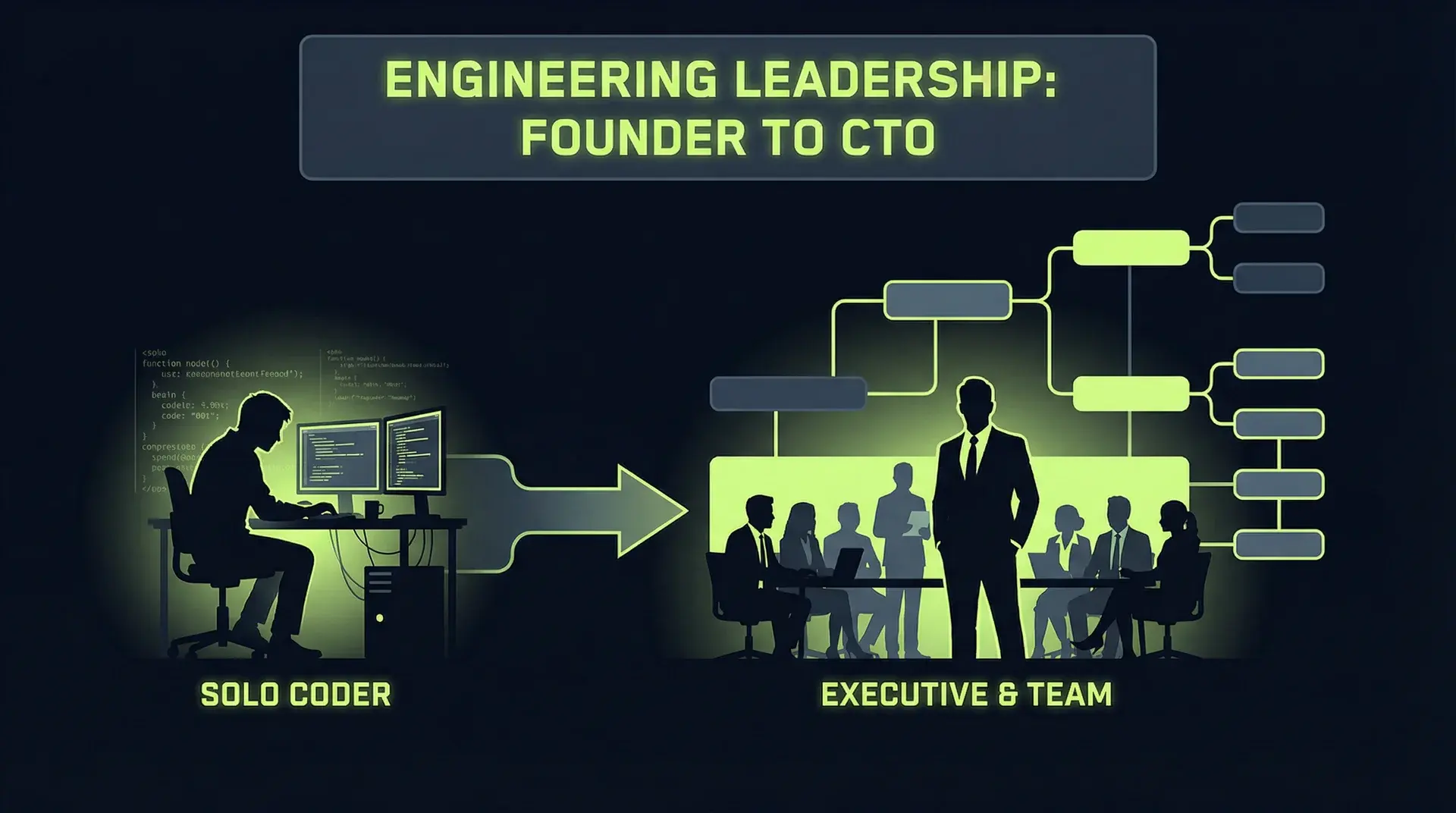
The journey from solo founder to CTO isn't linear... it's a series of phase transitions, each requiring different skills. At 1-3 engineers, you're a player-coach. At 5-10, you're building systems. At 15+, you're scaling an organization. The founders who succeed treat each transition deliberately: they hire strategically, accumulate technical debt intentionally, and know when fractional leadership beats full-time. This guide synthesizes the frameworks that work... from your first engineering hire through building a 50+ person organization.
Key Takeaways: Your first engineering hire should be a full-stack generalist with 4-7 years of experience, not a specialist. Most startups under $5M ARR do not need a full-time CTO...a fractional CTO at $2,000-$8,000/month provides strategic guidance without the $315K-$595K annual cost. Tech leads should follow the 30/30/30 rule: 30% coding, 30% review and mentoring, 30% architecture and planning. Work sample tests predict job performance at r=0.54, while years of experience predict at just r=0.18.
The Leadership Journey Nobody Prepares You For
Every technical founder starts the same way: writing code. Shipping features. Fixing bugs at midnight. The product is the priority, and you're the one building it.
Then something happens. Customers arrive. Revenue grows. The backlog expands faster than you can clear it. And suddenly you're not just building a product... you're building a team.
This transition catches founders off guard because the skills that made them successful as individual contributors become liabilities as leaders. The engineer who could solve any problem by coding harder becomes the bottleneck when they're still trying to write every critical feature themselves. The founder who made every technical decision becomes the blocker when their team waits for approval on routine choices.
I've advised 30+ founders through this journey. The pattern is consistent: the founders who struggle are the ones who try to scale themselves. The founders who succeed are the ones who learn to scale their impact through others.
This guide covers the complete journey... from hiring your first engineer to deciding whether you need a full-time CTO or a fractional alternative. It's not theory. It's the frameworks I've seen work across companies that made it from founder-as-engineer to engineering organization.
The Hiring Timeline: When to Add Each Role
The most consequential decisions you'll make as a technical founder are hiring decisions. Not because individual hires matter... though they do... but because the order and timing of hires determines your startup's trajectory for years.
The First Engineer: Your Most Important Hire
Your first engineering hire shapes everything that follows. They'll touch every part of the codebase, make architectural decisions that persist for years, and set the cultural template for everyone who comes after.
The ideal profile: a full-stack generalist with 4-7 years of experience. Not a specialist. Not a junior. Not a senior architect who hasn't shipped in years.
Why generalist? Because early-stage startups don't have 40 hours of frontend work and 40 hours of backend work. They have problems that cross boundaries. A React expert who can't write a database query will block you constantly.
Why 4-7 years? Less experience means they need mentorship you can't provide while running a company. More experience often means they're optimizing for architecture over shipping... exactly wrong for the pre-PMF phase.
For the complete playbook on your first five hires... including compensation benchmarks, interview process, and common mistakes... see Building Your First Engineering Team: The 5-Person Playbook.
The 5-Person Threshold: Specialists and Structure
Once you have 3-4 engineers, the dynamics shift. Your generalist can't cover everything anymore. You need depth.
The second and third hires should complement your first... if your generalist is strong on backend, hire frontend. If they're strong on frontend, hire backend. The goal is coverage, not depth. At this stage, you want to tackle any problem without waiting on a specific person.
Hire #4 or #5 should be a senior anchor: someone with 8-12+ years of experience who provides architecture ownership, code review authority, and mentorship capacity. This hire elevates everyone else.
The compensation math matters here. I've seen founders try to save money by hiring three juniors instead of one senior. The result is predictable: accumulated technical debt, architectural mistakes that take years to unwind, and seniors who eventually join and spend their first quarter cleaning up rather than building.
The economics of senior talent are counterintuitive but clear. For the full breakdown, including defect cost multipliers and team composition formulas, read The Senior Developer Paradox: Why Expensive Talent Saves Money.
The 15-Person Inflection Point
At 15 engineers, you stop being an engineering leader and start being an engineering executive. The skills that worked at 5 engineers become bottlenecks at 15.
This is the phase where founders most commonly struggle. They try to maintain the same hands-on leadership style that worked earlier. They review every PR. They make every architectural decision. They interview every candidate.
The result: the team can't ship without them. Decisions queue up waiting for founder approval. The fastest-shipping startup becomes the slowest.
The solution is organizational design. Multiple team leads. Clear ownership boundaries. Delegated decision-making authority. Career paths that don't all lead to "waiting for the founder to weigh in."
This is also when the fractional CTO question becomes urgent. At 15+ engineers, you need technical leadership at the executive level. The question is whether that means hiring a full-time CTO or engaging a fractional alternative.
For the decision framework... including the specific signals that indicate when each option makes sense... see Fractional CTO vs Full-Time CTO: When Each Makes Sense.
The 50-Person Horizon
At 50+ engineers, you're running an organization, not a team. The challenges are different:
- Multiple teams with different velocity and culture
- Cross-team dependencies that create coordination overhead
- Senior engineers who expect career growth paths
- Technical debt that's old enough to have its own technical debt
Most founders don't make it here still writing code. They're in strategy meetings, investor updates, and cross-functional alignment sessions. The CTO role becomes primarily about organizational design and technical strategy, not hands-on engineering.
The founders who succeed at this scale have usually done one of two things: they've hired executives who handle day-to-day operations while they focus on vision and strategy, or they've transitioned to a CEO role and hired a full-time CTO to lead engineering.
Either path requires letting go of the identity that got them here. That's harder than any technical challenge.
Team Progression Patterns: What Changes at Each Stage
Stage 1: The Player-Coach (1-3 Engineers)
At this stage, you're still an individual contributor. You happen to also be leading a tiny team.
Time allocation:
- 60-70% coding
- 15-20% code review and mentoring
- 10-15% architecture and planning
- 5-10% meetings and coordination
Key responsibilities:
- Ship the most complex features yourself
- Review all code before it merges
- Make all architectural decisions
- Hire and onboard new engineers
Common mistakes:
- Delegating too little (bottlenecking the team)
- Delegating too much too soon (quality problems)
- Treating code review as optional (debt accumulation)
Stage 2: The System Builder (5-10 Engineers)
At this stage, you're building systems... not just products, but processes. How code gets reviewed. How features get planned. How decisions get made when you're not in the room.
Time allocation:
- 30-40% coding
- 25-30% code review and mentoring
- 25-30% architecture and planning
- 10-15% meetings and coordination
Key responsibilities:
- Define technical standards and enforce them through review
- Create architectural guidelines that scale beyond your attention
- Develop your senior engineers into leaders
- Begin delegating architectural decisions with review
Common mistakes:
- Still making every decision personally
- Not investing in documentation and standards
- Hiring clones of yourself instead of complements
- Ignoring the management overhead of a growing team
The transition from IC to leader is the hardest phase for most technical founders. It requires fundamentally redefining what productivity means. For the tactical guide to this transition, including the 30/30/30 time allocation rule, see From IC to Tech Lead: Leadership Without the Title.
Stage 3: The Organization Designer (15-30 Engineers)
At this stage, you're no longer a technical leader with some management duties. You're a manager who happens to have technical expertise.
Time allocation:
- 10-20% coding (if any)
- 20-25% code review and mentoring leads
- 30-35% strategy and planning
- 25-30% meetings and coordination
- 10-15% hiring and people management
Key responsibilities:
- Design team structures that enable autonomy
- Develop tech leads into engineering managers
- Create career paths and growth frameworks
- Align technical strategy with business objectives
- Build relationships with other executives
Common mistakes:
- Still trying to be the best engineer on the team
- Creating organizational structures that route all decisions through you
- Neglecting the people side of leadership
- Failing to delegate hiring authority
Stage 4: The Executive (50+ Engineers)
At this stage, you're an executive. Your job is strategy, organizational health, and executive alignment.
Time allocation:
- 0-10% coding (likely zero)
- 5-10% technical review (architecture, not code)
- 35-40% strategy and planning
- 35-40% meetings and coordination
- 15-20% hiring, performance, and people
Key responsibilities:
- Set technical vision that spans years
- Build and develop your leadership team
- Represent engineering at the executive level
- Manage up (board, investors, CEO if different)
- Make high-stakes organizational decisions
The skills that matter at this stage... influence, communication, organizational design... are fundamentally different from the skills that got you here. Many technical founders find this transition uncomfortable. Some step back into CTO roles where they can be more hands-on. Some hire CTOs and move into CEO or chairman positions.
There's no wrong answer, only the one that fits your goals and the company's needs.
Tech Stack Impact on Hiring
Your technology choices have second-order effects on hiring that most founders underestimate.
The Talent Pool Equation
JavaScript/TypeScript and Python offer deep talent pools. Time-to-fill for generic roles runs 30-40 days. But abundance introduces filtering costs... the noise-to-signal ratio in the JavaScript market is exceptionally high.
Rust, Elixir, and Go present the opposite tradeoff. Smaller pools mean longer searches (45-60+ days), but the learning curve acts as a natural filter. Candidates for these roles tend to be more experienced and fundamentally stronger.
The compensation implications are significant. Rust developers command $175,000-$195,000 in the US... a 15-20% premium over baseline. For a Series A startup with ten engineers, choosing Rust over Python implies an additional $300,000-$500,000 in annual payroll.
The Innovation Tokens Framework
Dan McKinley, formerly of Etsy, proposed that organizations have limited capacity for technical novelty... roughly three "innovation tokens" to spend. Spend them on technology that supports your core differentiator. Spend them on non-differentiation, and you're accumulating debt with no payoff.
Instagram scaled to 14 million users with three engineers using PostgreSQL and Python. Shopify ran Rails from day one through IPO. These companies optimized for iteration velocity, not theoretical performance.
For the complete framework on technology selection as capital allocation... including when to spend innovation tokens and when to save them... see Choosing Your Startup's Tech Stack: A Capital Allocation Framework.
Build vs Buy at Scale
The build vs buy decision changes as your team grows. What makes sense at 5 engineers often doesn't make sense at 50... and vice versa.
Early Stage: Buy Almost Everything
Before product-market fit, every hour of engineering time should go to product. Building authentication, billing, or email infrastructure is a distraction. The time investment creates zero competitive differentiation.
The math is brutal. Authentication from scratch: 4-6 weeks of senior engineering time, plus ongoing security patches. Auth0 or Clerk: 1 day of integration. Billing from scratch: 2-3 months. Stripe Billing: days.
The "free" open source option isn't free. It shifts cost from dollars to hours. A senior engineer earning $180,000/year costs approximately $90/hour loaded. Every hour they spend on commodity infrastructure is an hour not spent on your product.
Growth Stage: Selective Building
As you scale, the calculus shifts. Some systems that made sense to buy now make sense to own:
- Components with tight product integration
- Systems where vendor limitations constrain features
- Infrastructure where costs scale faster than value
But most infrastructure remains buy-worthy. The question to ask: "Does owning this create competitive advantage?" If no, the answer is almost always buy.
Scale Stage: Strategic Ownership
At 50+ engineers, you have the capacity to own infrastructure strategically. The decision becomes financial: is the total cost of ownership lower than the vendor cost?
37signals exited AWS for this reason... their workloads were predictable enough that owning hardware became cheaper than renting elasticity they didn't need. Discord migrated from Go to Rust for their "Read States" service when Go's garbage collector created latency spikes that required over-provisioning.
These are scale-stage decisions. Don't let them distract you at earlier stages.
For the complete decision framework... including case studies and the reversibility test... see The Build vs. Buy Decision: When Free Actually Costs More.
Technical Debt Management Across Stages
Technical debt isn't inherently bad. It's strategic leverage... the ability to ship features before the codebase is perfect. The problem is unmanaged debt.
Pre-PMF: Accumulate Strategically
Before product-market fit, the dominant risk is building the wrong product. The codebase might be discarded entirely.
I advise pre-PMF startups to accept 30-40% higher debt loads than post-PMF companies. The math: if there's a 50% chance the codebase gets rewritten after PMF, the expected value of pre-PMF refactoring is halved.
This doesn't mean writing unmaintainable code. It means:
- Skip comprehensive test coverage for experimental features
- Accept hardcoded values that should be configurable
- Defer performance optimization until you have users
- Use quick-and-dirty integrations for unvalidated workflows
Post-PMF: Pay Down Before Scaling
Technical debt that's tolerable at current scale becomes catastrophic at 10x. The time to pay down is before the growth, not during.
The trigger I use: when you're at 10% of your target scale. If you're targeting 100,000 users, pay down at 10,000. This provides runway to refactor before the scaling pain arrives.
The 15-25% Rule
Healthy teams dedicate 15-25% of engineering capacity to debt reduction.
Below 15%, debt accumulates faster than it's paid. Above 25%, you're over-investing in perfection at the expense of product development.
Measuring Debt ROI
Not all debt deserves paydown. The formula:
Monthly Savings = (Hours Saved Per Month) × (Hourly Rate)
Refactoring Cost = (Refactoring Hours) × (Hourly Rate)
ROI = (Monthly Savings × 12) / Refactoring Cost
An ROI above 2.0 indicates the refactoring pays for itself within 6 months. Below 1.0, the debt is cheaper to carry than to pay.
For the complete debt management framework... including the distinction between deliberate and accidental debt, measurement approaches, and communication strategies... see Technical Debt Strategy: When to Accumulate, When to Pay Down.
The IC to Leader Transition
The most common failure mode for technical founders: staying an IC too long.
The Productivity Paradox
Research from Microsoft found that the top 1% of developers aren't 10x more productive in terms of code output. They're 10x more effective at preventing bad code from reaching production... through architecture decisions, code review, and early problem identification.
When you're an IC, you measure productivity in commits. As a leader, you measure productivity in team velocity. The first metric optimizes for your output. The second optimizes for outcomes.
The 30/30/30 Rule
The time allocation that works for tech leads:
| Activity | Percentage | What It Includes |
|---|---|---|
| Coding | 30% | Feature development, bug fixes, prototypes |
| Review & Mentoring | 30% | Code review, pairing, 1:1s, answering questions |
| Architecture & Planning | 30% | Design docs, roadmap input, technical strategy |
| Meetings | 10% | Standups, planning, retrospectives |
Most engineers attempting this transition discover they're still at 60-70% coding. The adjustment feels like slacking. It's not. It's investing.
Influence Without Authority
The engineers who transition successfully share one trait: they're already leading before anyone gives them permission.
This means:
- Solving blocking problems nobody assigned to you
- Reviewing PRs within hours, not days
- Making technical decisions quickly rather than letting the team spin
- Writing design documents that prevent architectural mistakes
- Giving code review feedback that teaches, not just critiques
For the complete transition playbook... including the 90-day plan and common failure modes... see From IC to Tech Lead: Leadership Without the Title.
The Fractional CTO Decision
At some point, every growing startup needs executive-level technical leadership. The question is whether that means a full-time hire or a fractional engagement.
| Factor | Fractional CTO | Full-Time CTO |
|---|---|---|
| Funding stage | Pre-seed through Series A...you need strategic decisions, not someone sitting in meetings | Series B+ fundraising...investors expect a full executive team |
| Founder profile | Non-technical founders needing translation between business goals and technical reality | Technology is your core differentiator...AI infrastructure, developer tools, or deep-tech requiring 24/7 obsession |
| Product maturity | Stable product, growth phase...engineering is maintenance and incremental features | Complex product requiring organizational design, career paths, and cross-team coordination |
| Team size | Under 15 engineers | Engineering team over 15...this is a full-time job |
| Sales motion | Self-serve or SMB sales | Enterprise sales...customers want to meet your CTO and discuss roadmap, security, and integration |
The Transition Point
The numbers that matter:
| Signal | Threshold |
|---|---|
| Engineering team size | 12-15 engineers |
| Annual revenue | $5-10M ARR |
| Funding stage | Series A closed or B planned |
| CTO hours needed | >30/week consistently |
If you're hitting multiple thresholds, start the search. It takes 3-6 months to hire a good CTO.
For the complete decision framework... including cost comparison, what to look for in a fractional CTO, and how to structure the engagement... see Fractional CTO vs Full-Time CTO: When Each Makes Sense.
Hiring Decision Framework
At every stage of your journey, hiring decisions are the highest-leverage work you do. The frameworks that work:
The Validity Hierarchy
Frank Schmidt and John Hunter's meta-analysis of 85 years of personnel selection research established what predicts job performance:
| Method | Validity Coefficient (r) | Interpretation |
|---|---|---|
| Work Sample Tests | 0.54 | Best predictor available |
| Structured Interviews | 0.51 | Consistent questions, rubric scoring |
| Unstructured Interviews | 0.38 | The "gut feel" approach |
| Years of Experience | 0.18 | Nearly useless |
Years of experience... the primary filter on most job listings... has a validity coefficient barely above random chance. Stop reading resumes. Start testing actual work.
Work Sample Design
The task should mirror real work:
Bad: "Reverse a linked list on a whiteboard."
Good: "Here's a Next.js component with a bug. The loading state shows briefly, then disappears before data arrives. Find and fix the bug. You have 90 minutes."
Evaluate process, not just output. The candidate who writes imperfect code but clearly explains their tradeoffs often outperforms the candidate with perfect code and no explanation.
Red Flags and Green Flags
| Red Flags | Green Flags |
|---|---|
| Title inflation ("Senior" with 3 years of experience) | Admits uncertainty ("I'm not sure, but I'd approach it by...") |
| Cannot explain their own code | Tradeoff thinking ("The advantage is X, but the downside is Y") |
| No questions about the problem domain | Questions first, coding second |
| Framework knowledge without fundamentals | System awareness (how their code fits the larger architecture) |
| No production war stories | Failure reflection (owns mistakes, explains what they learned) |
For the complete hiring framework... including interview structure, the STAR framework for behavioral questions, and the cost of bad hires... see Beyond the Resume: A Technical Founder's Hiring Framework.
The Leadership Evolution Summary
The journey from founder to CTO isn't about learning one set of skills. It's about learning... and unlearning... multiple sets of skills at each phase.
| Phase | Team Size | Identity | Measure | Key Skill | Transition Challenge |
|---|---|---|---|---|---|
| 1. Solo Founder | 0-1 engineers | Engineer | Code shipped | Technical execution | Accepting that you can't do everything yourself |
| 2. Player-Coach | 1-5 engineers | Technical leader who codes | Team velocity | Delegation and code review | Spending less time coding, more time enabling |
| 3. System Builder | 5-15 engineers | Engineering manager with technical depth | Team capabilities and architecture quality | Process design and people development | Creating systems that work without you |
| 4. Organization Designer | 15-50 engineers | Executive with engineering background | Organization health and strategic alignment | Organizational design and executive influence | Leading through other leaders |
| 5. Technical Executive | 50+ engineers | Executive | Company outcomes | Vision, strategy, and board management | Letting go of technical identity |
Each transition requires mourning the previous identity. The engineer who loved writing code becomes the leader who loves enabling engineers who write code. The hands-on manager becomes the executive who builds organizations that manage themselves.
This is hard. It requires intentionality, self-awareness, and often external support... whether from a coach, a peer group, or a technical advisor who has made the journey before.
Where to Go From Here
This hub connects the detailed frameworks for each aspect of engineering leadership:
Hiring and Team Building:
- Building Your First Engineering Team: The 5-Person Playbook ... The sequence that works for your first five hires
- Beyond the Resume: A Technical Founder's Hiring Framework ... Work samples, structured interviews, and predictive validity
- The Senior Developer Paradox: Why Expensive Talent Saves Money ... The economics of experience
Technical Strategy:
- Choosing Your Startup's Tech Stack: A Capital Allocation Framework ... Technology decisions as investment decisions
- The Build vs. Buy Decision: When Free Actually Costs More ... When to build, when to buy, when to outsource
- Technical Debt Strategy: When to Accumulate, When to Pay Down ... Strategic debt management
Leadership Transitions:
- From IC to Tech Lead: Leadership Without the Title ... The mindset shift from producer to multiplier
- Fractional CTO vs Full-Time CTO: When Each Makes Sense ... The decision framework for executive technical leadership
The Decision You're Facing
If you're reading this, you're probably at an inflection point. Maybe you're about to make your first hire. Maybe you're at 10 engineers and feeling the organizational complexity for the first time. Maybe you're wondering whether you need a fractional CTO or a full-time one.
The frameworks in this guide and the linked posts aren't academic. They're the patterns that work across dozens of startups I've advised.
But frameworks only get you so far. Every company has context that doesn't fit the pattern. Every founder has strengths and weaknesses that shape which approach will work.
If you're making one of these decisions right now and want a second opinion... on timing, on structure, on specific candidates, on whether you're ready for the next phase... that's the kind of strategic guidance I provide.
The cost of getting these decisions wrong is measured in years. The cost of getting them right compounds in your favor.
Frequently Asked Questions
When should a startup hire its first CTO?
Most startups under $5M ARR do not need a full-time CTO. A fractional CTO at 8-20 hours per month ($2,000-$8,000/month) provides strategic guidance without the $315K-595K annual cost of a full-time hire. Hire a full-time CTO when you have 15+ engineers and architectural decisions require daily leadership presence.
What is the difference between a fractional CTO and a full-time CTO?
A fractional CTO provides strategic architecture guidance, technical due diligence, and team mentorship at 8-20 hours per month. A full-time CTO manages daily engineering operations, hiring, team culture, and long-term technical vision. The fractional model works at pre-Series A when you need experience without the overhead. The full-time model becomes necessary when team size and technical complexity require dedicated leadership.
How do I transition from individual contributor to tech lead?
The biggest shift is from personal output to team output. Follow the 30/30/30/10 rule: 30% coding, 30% code review and architecture, 30% mentoring and communication, 10% process improvement. The transition typically takes 12-18 months. The hardest part is measuring success by team velocity rather than personal commits.
What makes a senior developer actually senior?
Senior developers multiply team output rather than just maximizing personal output. They anticipate problems before they become incidents, make decisions that reduce future complexity, and mentor others without being asked. The paradox: the best senior developers often write less code because they spend time preventing unnecessary code from being written.
How do I build my first engineering team as a non-technical founder?
Start with a strong first hire who can be both architect and builder. Your first 5 engineers should be generalists, not specialists. Use work sample tests (correlation with job performance: r=0.54) instead of resume screens (r=0.18). Budget $150K-200K base salary for your first senior engineer in a major market, or hire remote at 60-70% of that.
Building an engineering organization? I work with founders from first hire through Series B on the decisions that determine whether your team becomes a competitive advantage or a constraint.
Technical Advisor for Startups ... Strategic guidance for founders navigating the leadership journey.